Переосмислення теоретичної моделі та методологічного інструментарію мemory studies в умовах російсько-української війни
Автор(и)
Файли
##plugins.themes.individualizeTheme.highlightedArticleDetails##
Журнал
##plugins.themes.individualizeTheme.publishedInIssue##
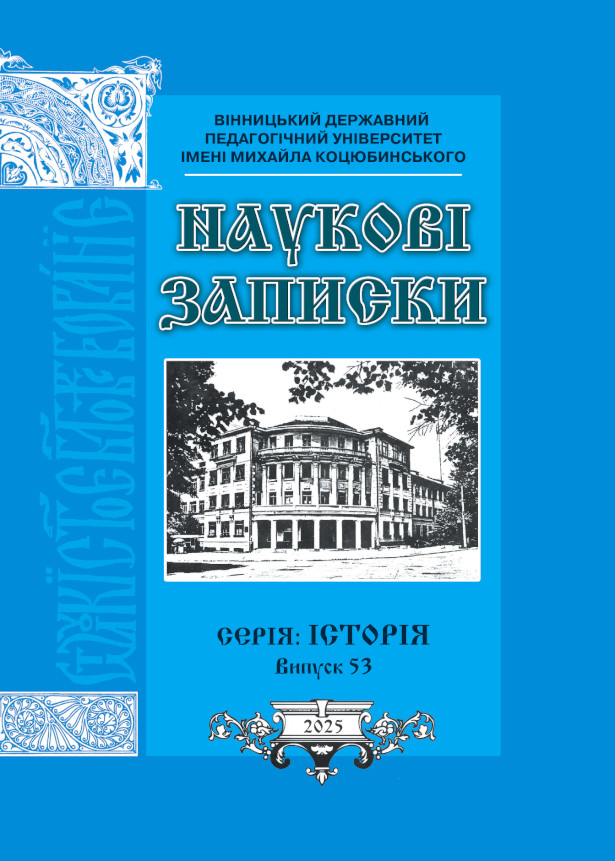
В журналі висвітлюються актуальні проблеми історії України, всесвітньої історії, історичного краєзнавства, етнології, історіографії, джерелознавства, теорії та методології історії, рецензуються найсучасніші монографічні праці в галузі історичних наук. Видання розраховане на науковців, краєзнавців, викладачів, аспірантів, студентів, усіх, хто прагне отримати ґрунтовні знання теоретичного і прикладного характеру з історії.
Рішенням Міністерства освіти і науки України збірник включено до Переліку наукових фахових видань (категорія Б), в яких можуть публікуватися результати дисертаційних робіт з історичних наук. (Наказ МОН України №409 від 17.03.2020 р.).
Про журналАнотація
Метою статті є обґрунтування доцільність вироблення нової теоретичної моделі мemory studies та результативного методологічного інструментарію студіювання українського мнемонічного простору в умовах російсько-української війни, виходячи з потреби їхньої корекції та практичної протидії історичній пропаганді країни-агресора РФ. Методологія дослідження. Пропоноване дослідження проведене з використанням методологічних підходів мemory studies та компаративної історіографії, які дозволили виявити та описати існуючи та перспективні теоретичні моделі студіювання мнемонічної сфери. Продуктивність самих теоретичних парадигм з’ясовувалася шляхом емпіричної верифікації первинної наукової гіпотези про екстремальний режим пам’яті в умовах агресії. Наукова новизна дослідження полягає у переосмисленні існуючих теоретичних підходів та методологічного інструментарію мemory studies, яке зумовлене новими викликами, що постали перед дослідниками в умовах російської агресії проти України. Запропонована деконструкція теоретичних засад моделі «пострадянського націоналістичного конфлікту» та концепцій «західного епістемологічного колоніалізму». Висновки. Аргументована необхідність подолання системної методологічної помилки – ігнорування факту російської агресії, не тільки військової, але й пам’яттєвої. Запропоновано відмовитися від опису політики пам'ять як антагоністичної у рамках моделі «пострадянського націоналістичного конфлікту». Розглянуто більш продуктивну і перспективну альтернативу теоретичну модель пам’яті «різних цивілізацій», а саме конфлікту між центрально-східноєвропейською культурою пам’яті та євразійською. Зроблено припущення, що такий підхід може наблизити до вичерпання потенціалу антагоністичної пам’яті і відкрити можливості до формування культури агоністичної пам’яті. Пропонується зосередитися на аналізі трансформації різних типів мнемонічних діячів (акторів пам’яті) та режимів пам’яті. Обґрунтовано, що деконструкція репресивного типу історичного пам’яттєвого дискурсу держави-агресора РФ становить одночасно теоретичний науковий, і практичний соціальний інтерес.
Посилання
Assman, A. (2012). Prostory spohadu. Formy ta transformatsii kulturnoi pamiati. per. z nim. [Spaces of Memory. Forms and Transformations of Cultural Memory. Trans. from German]. Kyiv.
Assman, Jan. (2004). Kulturnaya pamyat: Pismo, pamyat o proshlom i politicheskaya identichnost v visokikh kulturakh drevnosti. per. s nem. [Cultural Memory: Writing, Memory of the Past, and Political Identity in the High Cultures of Antiquity. Trans. from German]. Moscow.
Bernard-Kovalchuk, N. (2025) Skladnoshchi freimuvannia: istorychne pysmo v umovakh viiny. [The Complexities of Framing: Historical Writing in Wartime]. Krytyka - Criticism. Cherven – June. https://Krytyka.com/ua/articles/skladnoshchi-freimuvannia-istorychne-pysmo-v-umovakh-viiny?
Bertrand, J. (2009). Porazka Yevropeiskoho soiuzu v kiprskomu identychnisnomu konflikti. [The defeat of the European Union in the Cypriot identity conflict]. Yevropa ta yii bolisni mynuvshyny. per. z fr. – Europe and its painful past. Trans. from French. Kyiv. 208-219.
Connerton, P. (2004). Yak suspilstva pamiataiut. [How societies remember]. Kyiv.
Demshuk, A. (2012). The Lost German East: Forced Migration and the Politics of Memory, 1945-1970. Cambridge: Cambridge University Press, 2012. https://doi.org/10.1017/CBO9781139107303
Dialogues with Time (2008) Dialogi so vremenem: pamyat o proshlom v kontekste istorii. red. L. P. Repina. [Dialogues with Time: Memory of the Past in the Context of History. ed. L. P. Repina]. Moscow.
Edwards, S. (2015). Allies in Memory. World War II and the Politics of Transatlantic Commemoration, 1941-2001. Cambridge: Cambridge University Press. https://doi.org/10.1017/CBO9781139696999
Halbwachs, M. (1968). La memoire collective. Paris: Presses Universitaires de France. [Collective memory. Paris: Presses Universitaires de France].
Halbwachs, M. (2007). Sotsialnie ramki pamyati. per. s fr. [Social frameworks of memory. Trans. from French]. Moscow.
History and Memory (2006) Istoriya i pamyat: istoricheskaya kultura Yevropi do nachala Novogo vremeni. red. L. P. Repina. [History and Memory: Historical Culture of Europe before the Beginning of the Modern Age. ed. L. P. Repina]. Moscow.
Hrytsenko, O. (2022). Dekomunizatsiia v Ukraini yak derzhavna polityka i yak sotsiokulturne yavyshche. Vyd. druhe, dop. upor. N. Honcharenko. [Decommunization in Ukraine as a state policy and as a socio-cultural phenomenon. Second ed.]. Kyiv.
Hutton, P. (2003). Istoriya kak iskusstvo pamyati. per. s angl. [History as an Art of Memory. Trans. from English]. Saint Petersburg.
Ilnytskyi, V., Telvak, V. (2024). Ukraine under the conditions of the second year of existential war in analysts' reflections of the Warsaw Centre for Eastern studies. East European Historical Bulletin. № 31. 218-237. https://doi.org/10.24919/2519-058X.31.306344
Ivangorodsky, K. (2024). Dehumanization of Ukrainians and demonization of Ukraine by Russian historiography as a means of justifying the so-called "SMO". Bulletin of Cherkasy University. Series "Historical Sciences". № 1. 8-24. https://doi.org/10.31651/2076-5908-2024-1-8-24
Johnson, E. (2018). Cultural Memory, Memorials, and Reparative Writing. Houndmills, Basingstoke, Hampshire: Palgrave Macmillan. https://doi.org/10.1007/978-3-030-02098-9
Kasianov, G. (2018). Past continuous. Istorychna polityka 1980-kh-2000-kh: Ukraina ta susidy. [Past continuous. Historical politics of the 1980s-2000s: Ukraine and its neighbors]. Kyiv.
Kasianov, G. (2018а). Tolkovaniya OUN i UPA v publichnom diskurse Ukraini 1990-kh-2000-kh gg.: ot «reabilitatsii» k apologii. [Interpretations of the OUN and UPA in the public discourse of Ukraine in the 1990s-2000s: from "rehabilitation" to apology]. Forum noveishei vostochnoevropeiskoi istorii i kulturi. – Forum of Modern Eastern European History and Culture. №1-2. 257-279. http://www1.ku-eichstaett.de/ZIMOS/forum/inhaltruss29.html
Kasianov, G. (2021). Ukraine as a "Nationalizing State": A Review of Practices and Outcomes]. Sociology of power. 33 (2): 117-146. https://doi.org/10.22394/2074-0492-2021-2-117-146
Kasianov, G. (2021а). "Decommunization" in Ukraine, 2014-2021: Process, Actors, Results. Historical expertise. № 4(29). 174- 200. https://doi.org/10.31754/2409-6105-2021-4-174-200
Kasianov, G. (2022). Challenges of antagonistic memory: Scholars versus politics and war. Memory Studies. vol. 15(6). 1295 -1298. https://doi.org/10.1177/17506980221133517
Kasianov, G. & Osipchuk, S. (2017). Istoricheskaya politika v Ukraine v kontekste konflikta s Rossiei, 1990-2017. [Historical politics in Ukraine in the context of the conflict with Russia, 1990-2017]. Neobektivnie konflikti: Politicheskie praktiki razdeleniya obshchego proshlogo. Rossiya, Ukraina, Moldova i Pridnestrove: analiz i rekomendatsii. red. S. Rumyantsev. – Non-Objective Conflicts: Political Practices of Dividing a Common Past. Russia, Ukraine, Moldova and Transnistria: Analysis and Recommendations. ed. S. Rumyantsev. Berlin. 57-96.
Koposov, N. (2011) Pamyat strogogo rezhima: Istoriya i politika v Rossii. [Memory of the Strict Regime: History and Politics in Russia]. Moscow.
Koposov, N. (2018). Memory Laws, Memory Wars. The Politics of the Past in Europe and Russia. Cambridge: Cambridge University Press. https://doi.org/10.1017/9781108304047
Kubik, Jan. & Bernhard, Michael. (2014). A Theory of the Politics of Memory. Twenty Years after Communism: The Politics of Memory and Commemoration, edited by Jan Kubik and Michael Bernhard. Oxford: Oxford University Press. 7-36. https://doi.org/10.1093/acprof:oso/9780199375134.003.0002
Kyridon, A. M. (2016). Heteropii pamiati: Teoretyko-metodolohichni problemy studii pamiati. [Heteropias of Memory: Theoretical and Methodological Problems of Memory Studies]. Kyiv.
Lagrou, Р. (1999). The Legacy of Nazi Occupation. Patriotic Memory and National Recovery in Western Europe, 1945-1965. Cambridge: Cambridge University Press. https://doi.org/10.1017/CBO9780511497087
Leaders of Eastern European countries (2022) Kerivnyky skhidnoievropeiskykh derzhav napysaly lyst-zvernennia pro yevropeisku pamiat. [Leaders of Eastern European states wrote a letter of appeal about European memory]. https://www.istpravda.com.ua/short/2022/08/3/161638/ [in Ukrainian].
Masnenko, V., Telvak, V., Telvak, V, Yanyshyn, B. (2021). Identity transformation of the Ukrainian Donbas: from the "Wild field" to Russian occupation. Analele Universităńii din Craiova. Istorie. Nr. 2 (40). 101-114. https://doi.org/10.52846/AUCSI.2021.2.08
Masnenko, V. V. (2022). Methodological aspects of studying the politics of memory in the Ukrainian territories occupied by the Russian Federation. Panel discussion "Russia's War against Ukraine 2014-2022: Historical Retrospective and Attempts at Scientific Reflection" (May 19-20, 2022)]. Ukrainian Historical Journal. № 4. 47-50. http://resource.history.org.ua/publ/UIJ_2022_4_3
Memory and Cultural History (2014) Memory and Cultural History of the Spanish Civil War: Realms of Oblivion. еd. Aurora G. Morcillo. Leiden-Boston: Brill.
Memory and Theory (2013) Memory and Theory in Eastern Europe. ed. Uilleam Blacker, Alexander Etkind & Julie Fedor. New York: Palgrave Macmillan.
Methodological issues (2018) Metodologicheskie voprosi izucheniya politiki pamyati: Sb. nauchn. tr. red. A. I. Miller, D. V Yefremenko. [Methodological issues in studying the politics of memory: Collection of scientific papers. edited by A. I. Miller, D. V. Efremenko]. Moscow Ukrainian Historical Journal Saint Petersburg.
Miller, A. (2000). Russia and Europe in memory wars. Oslo: Published by the Norwegian Institute of International Affairs.
Miller, A. I. (2016). The Politics of Memory in Post-Communist Europe and its Impact on the European Culture of Memory]. Politeia. № 1. 111-121. https://doi.org/10.30570/2078-5089-2016-80-1-111-121
Miller, A. I. (2023). Talking Politics: Vladimir Putin's Narrative on Contemporary History (2019-2022). Russia in Global Affairs. 21(2). 58-75. https://doi.org/10.31278/1810-6374-2023-21-2-58-75
Miller, A. I. (2024). Global Memory Culture in Doubt. Russia in Global Affairs. 22(3). 32-44. https://doi.org/10.31278/1810-6374-2024-22-2-32-44
Miller, А. I. (2020а). Russia and Europe in Memory Wars. Political Use of the Past in Russia and Abroad: Collection of essays. ed. Miller A. I., Malinova O. Y., Efremenko D. V., Voronovici A. A. Moscow. 211-223.
Miller, А. I. (2022). Empathy Is the Best Strategy for Diplomacy. National Identity in Ukraine: History and Politics. Russia in Global Affairs. 20(3). 94-114. https://doi.org/10.31278/1810-6374-2022-20-3-94-114
Minakov, M. (2020). Othering from within. The ideological function of Ukrainian Institute of National Remembrance in 2015-2018. Ideology And Politics Journal. № 2 (16). 215-228.
Nagorna, L. (2012). Istorychna pamiat: teorii, dyskursy, refleksii. [Historical memory: theories, discourses, reflections]. Kyiv.
Nora, P. (2014). Teperishnie, natsiia, pamiat. per. z fr. [Present, nation, memory. Trans. from French]. Kyiv.
Plekhanov, A. A. (2018). The Destruction of the Space of Soviet Symbolic Domination in Post-Soviet Ukraine. Political Science. № 3. 231-263. https://doi.org/10.31249/poln/2018.03.10
Poletaev, A. V. & Savelyeva, I. M. (2006). Znanie o proshlom: teoriya i istoriya. T. 2. «Obrazi proshlogo». [Knowledge of the Past: Theory and History. Vol. 2. Images of the Past]. Saint Petersburg.
Riepina, L. (2013). Indywidualne i ponadindywidualne w konceptualizacji pamięci: od dychotomii do syntezy. [Individual and supra-individual in the conceptualization of memory: from dichotomy to synthesis]. Sensus Historiae. Vol. XI (2). 43-56.
Rudling, Per A. (2024). Tarnished Heroes: The Organization of Ukrainian Nationalists in the Memory Politics of Post-Soviet Ukraine, ibidem-Verlag, Hannover, Stuttgart.
Rudling, Per A. (2024а). Repatriating An Edifying Past: The Diaspora Ukrainian Authoritarian Right and Power Over Memory, 1991-2021. Nationalities Papers 52: 1308-1331. https://doi.org/10.1017/nps.2024.47
Rüsen, J. (2010). Novi shliakhy istorychnoho myslennia. per. z nim. [New Ways of Historical Thinking. Trans. from German]. Lviv.
Savelyeva, I. M. & Poletaev, A. V. (2003). Znanie o proshlom: teoriya i istoriya: V 2 t. T. 1: Konstruirovanie proshlogo. [Knowledge of the Past: Theory and History: In 2 volumes. Vol. 1: Construction of the Past]. Saint Petersburg.
Stora, B. (1999). Le transfert d'une mémoire: de l'«Algérie française» au racisme anti-arabe. Paris, La Découverte. [The Transfer of Memory: From "French Algeria" to Anti-Arab Racism. Paris, La Découverte].
Stora, B. (2009). Frantsiia y Alzhyr u pastkakh pamiati [France and Algeria in memory traps]. Yevropa ta yii bolisni mynuvshyny. per. z fr. – Europe and its painful past. Trans. from French. Kyiv. 40-50.
Suleiman, S. (2006) Crises of Memory and the Second World War. Cambridge, London: Harvard University Press.
Symbolic aspects (2021) Simvolicheskie aspekti politiki pamyati v sovremennoi Rossii i Vostochnoi Yevrope. red. V. V. Lapin, A. I. Miller. [Symbolic Aspects of Memory Politics in Contemporary Russia and Eastern Europe. ed. V. V. Lapin, A. I. Miller]. Saint Petersburg.
Telvak, V., Ilnytskyi, V. (2023). A year of existential war in analytical reflections of the Warsaw Centre for Eastern studies. East European Historical Bulletin. № 27. 249-258. https://doi.org/10.24919/2519-058X.27.281552
The Invention of Tradition (1983). ed. E. Hobsbawm and T. Ranger. Cambridge: Cambridge University Press.
Voronovich, A. A. (2018). The Role of European Memory Policy in State Historical Policy of Moldova and Ukraine in the 2000s]. Political Science. № 3. 204-230. https://doi.org/10.31249/poln/2018.03.09
Weber, С. (2015). Social Memory and War Narratives. Transmitted Trauma among Children of Vietnam War Veterans. Houndmills: Palgrave Macmillan. https://doi.org/10.1057/9781137496652
Yurchuk, Y. (2017). Reclaiming the past, confronting the past: OUN-UPA memory politics and nation-building in Ukraine (1991-2016). War and memory in Russia, Ukraine and Belarus. J. Fedor et al. (eds). New York. Palgrave Macmillan. 107-137. https://doi.org/10.1007/978-3-319-66523-8_4
Zayarnyuk, A. (2022). Historians As Enablers? Historiography, Imperialism, and the Legitimization of Russian Aggression. East/West: Journal of Ukrainian Studies. October 26. Vol. IX. No. 2. 191-212. https://doi.org/10.21226/ewjus754
Сonnerton, Р. (1989). How Societies Remember. Cambridge: Cambridge University Press, 1989. https://doi.org/10.1017/CBO9780511628061
Сonnerton, Р. (2009). How Modernity Forgets. Cambridge: Cambridge University Press, 2009. https://doi.org/10.1017/CBO9780511627187
##plugins.themes.default.displayStats.downloads##
Подробиці
Ліцензія
Авторське право (c) 2025 Vitalii Masnenko, Vitalii Telvak

Ця робота ліцензується відповідно до ліцензії Creative Commons Attribution 4.0 International License.